

Let’s start with a simple poker game, “In Between”.
If you didn’t know what it is, the rules are basically as below:
Everyone puts equal money into a pot.
You get 2 cards face up. Ace = 1, King = 13.
Bet any amount up to the pot size on whether the next card falls between your two cards.
It’s between → you win that amount from the pot.
It’s outside → you pay that amount into the pot.
It matches one of your cards → ouch, you pay double.
Play passes left. Game ends when the pot is empty (or everyone re-antes).
Now the question is if you have N amount of times getting A,K, which is the widest spread, how much should you bet each time in order to turn RM100k to RM50 mil?
And the marks are as below:
1. >50m, 5 points
2. 10m-50m, 3 points
3. 3m-10m, 1 point
4. 0-3m, 0 point
5. Negative at any point of the game, -5 points
(You’re allowed to use LLM to check on the answer)
Korea, as a market, genuinely is the most speculative retail environment on earth, and it’s measurable:
Korean retail investors poured roughly $10B into leveraged ETFs this year, to the point that economists are calling the market a “gambling den” and regulators just tripled deposit thresholds. The SK Hynix 2x ETF crash this month handed retail ~70% losses, and Korean media itself calls it a “Squid Game stock market” and a casino for one-day wagers. Koreans are also famously the dominant foreign retail buyers of US triple-leveraged products.
Crypto: ~16 million Koreans trade coins — a third of the country — and the “kimchi premium” (Korean exchanges pricing BTC above global markets) has an actual finance literature; Kim & co.’s paper in Finance Research Letters ties it directly to speculative retail demand.
Gambling proper: Williams, Lee & Back’s prevalence study found notable problem-gambling rates in Korea despitecasino gambling being illegal for locals (except one remote casino, Kangwon Land). That prohibition matters — it channels the gambling impulse into the two legal high-variance venues: stocks and crypto.

BUT WHY IS IT ALWAYS KOREAN?
as real returns compress, risk increases to compensate.
According to a survey by the Korea Development Institute last year, only 30 percent of respondents believe their children will achieve a higher socioeconomic status than their own.
Choi Kyung-min, 33, describes himself and his wife as having been born with a “dirt spoon” in their mouths, meaning they come from less privileged backgrounds.
Both graduated from university with student loans to pay back, and their parents are unprepared for retirement. Now renting a small apartment in Gyeonggi Province, they support their parents financially while trying to save as much as possible. However, it would take more than 10 years of saving to afford buying a home in Seoul of a similar size to their current one.
“When a couple has a baby, they have hope that their child will have a better life than their own. We don’t have such unrealistic expectations or hopes,” he said.
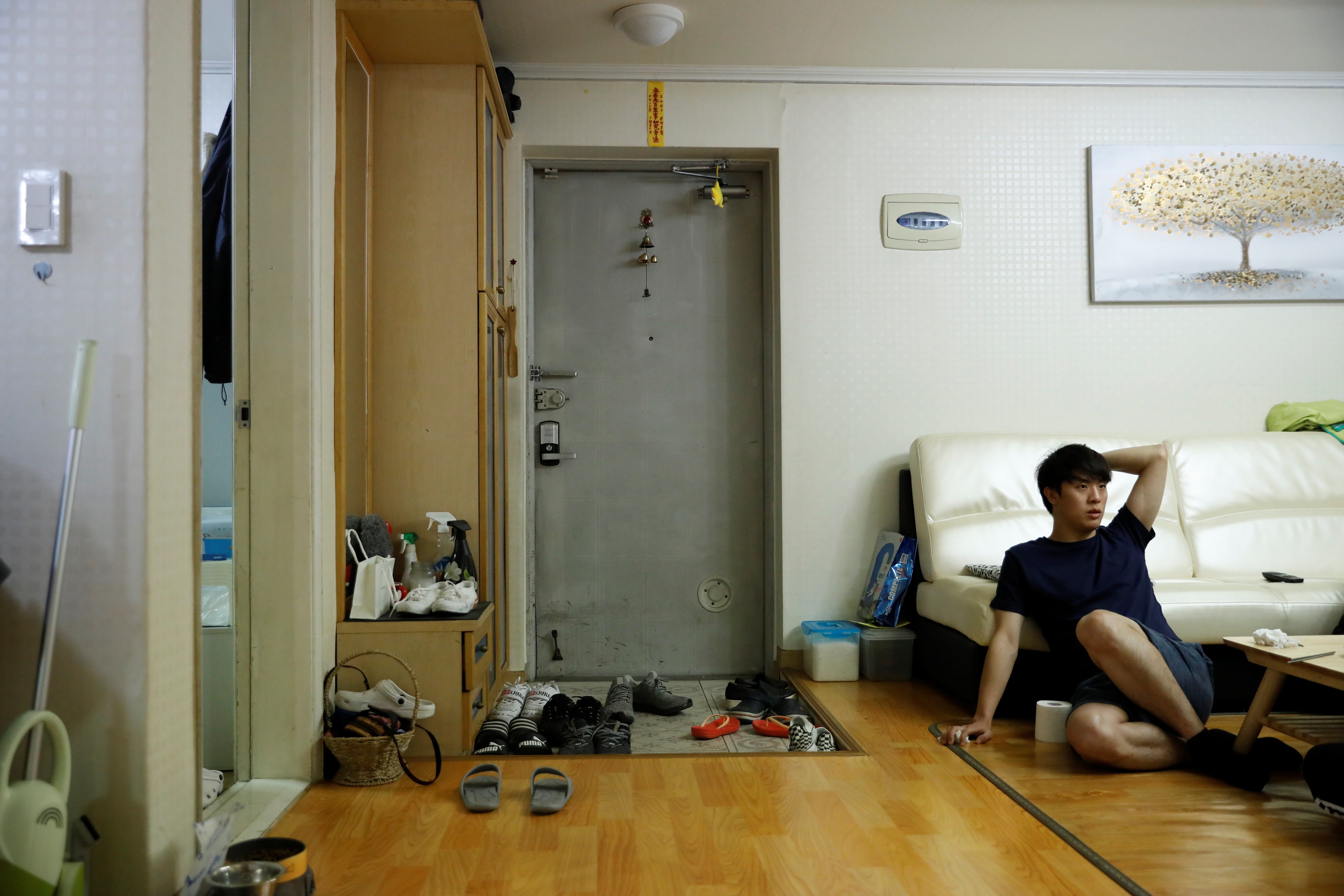
Once born with a dirt spoon, the theory goes, there’s no escaping one’s disadvantaged socioeconomic background, and it is highly likely that one will pass it on to one’s child as well. This is why Choi and his wife have decided not to have children.
Shin Kwang-yeong, an emeritus professor of sociology at Chung-Ang University, sums it up: The once-popular phrase, “a dragon rises from a small stream,” is no longer valid in South Korean society.
“During South Korea’s rapid economic development, the prevailing mantra was that if a child — even from a poor family — studied hard, excelled academically and got into a good university, they could become a lawyer or doctor,” Shin said.
“But now, the first rung of the social ladder is broken because a child’s chances at entering top universities are largely determined by their parents’ wealth.”
In behavioral economics, demand for lottery-like bets rises when normal-effort paths to your aspiration level are blocked (Friedman-Savage utility, prospect-theory aspiration models). Korea is close to a lab experiment for this: Seoul apartments cost 15-20x median income, social mobility is widely described as a "broken ladder", the "dirt spoon / gold spoon / Hell Joseon" discourse says your class is fixed at birth, and salary income mathematically cannot buy the life your parents' generation got. Why do rational people buy insurance and lottery tickets? Answer — when there's a wealth threshold that changes your life (an apartment, escaping your class) and no continuous path reaches it, a negative-EV, high-variance bet becomes the only strategy with nonzero probability of arrival. Saving 30% of a salary for 40 years arrives at 60, too late, with certainty. A 10x coin arrives at 34, with 5% probability. If the aspiration is binary, the gamble is not irrational — it's the rational response to a broken deterministic path. Bloomberg found young Koreans explicitly abandoning homeownership to pile into stocks, and more than 1 in 5 young Korean adults is now heavily in debt. There's even a common phrase for the crypto bet: "Gangnam or the Han River."

Second, the country’s own history validates the gamble. In 1961 South Korea's GDP per capita was below Ghana's. The founding story every Korean knows: in 1971 Chung Ju-yung, a peasant's son who founded Hyundai, flew to Barclays in London to borrow money to build supertankers. He had no shipyard. When asked for credentials, he pulled out a 500-won banknote showing the 16th-century turtle ship and said, in effect, we were building ironclads while you were building rowboats — got the loan, sold ships he couldn't yet build, and constructed the shipyard and the first two tankers simultaneously on an empty beach at Ulsan. It worked. Today Korea is one of the top shipbuilders on earth. Now: what lesson does a nation absorb from going dirt-poor to richer than Japan per capita in one lifetime, on exactly this kind of audacity? It absorbs the all-in bet is how our world was built. Sociologist Chang Kyung-Sup calls this "compressed modernity" — 200 years of Western development in 40。 The national memory says extreme bets on growth pay off, and pali-pali (hurry-hurry) culture compresses time horizons further.
Third, leverage was already normalized at the kitchen table. Korea's unique jeonse housing system: instead of monthly rent, tenants hand landlords a lump-sum deposit of 60-80% of the property's value, returned after two years. Functionally, every landlord is receiving a massive interest-free loan from their tenant — and the national sport of gap tuja ("gap investing") is buying an apartment with only the sliver between price and jeonse deposit, i.e., 5-10x leveraged property speculation performed by ordinary middle-class families. A society where your aunt runs a leveraged carry trade as a normal retirement plan does not view a 3x ETF as exotic.

Back to our first question, how do you turn 100k to 50m?
if we view every ladder of “points” as a level of wealth, getting through each requires a different thing.
A-K wins 88% of the time, so the edge is somehow similar in every scenario.The only thing that changes is N — how many good chances you get.
N = 50 chances: bet 32%, every single time.
This is calculated using Kelly Criterion. With 50 shots, you don't need any hand to be special. You just need discipline. Steady compounding gets you past 50M about 44% of the time. When opportunities are abundant, boring is optimal. This is the trust-fund kid's math: plenty of chances, so never risk the seat at the table.
N = 20 chances: bet 41%. Kelly is no longer enough.
Run the "correct" 32% for only 20 hands and your median outcome is ~RM2M — you don't even make the scoreboard. To reach the top tiers you must overbet — push past the mathematically optimal size, accept violent swings, and keep a small repair budget for when a hand goes wrong. The middle class squeeze, in card form: enough chances that strategy still matters, too few for patience alone to work.
N = 10 chances: bet 46%, and accept that 50M is impossible.
With only 10 hands, no legal bet size reaches 50M — the top tier mathematically does not exist for you. Your best play is to shove nearly half your stack every hand, win 9 in a row (a 32% shot), and land at 3M. Not because you're greedy or stupid. Because every safer strategy guarantees zero.
Conclusion:
A 25-year-old in 1975 Korea had N = 50: a growing economy handing out A-K hands for decades. Chung Ju-yung’s supertanker bet looks insane until you realize the whole country was playing with a huge N — crash out, and growth deals you another hand.
A 33-year-old “dirt spoon” couple in Gyeonggi today, staring at 15-20x income-to-price housing? They’re playing N = 10. Saving 30% of salary is the “safe” strategy that lands at zero — arriving at the threshold at age 60, too late, with certainty. The 2x leveraged ETF, the coin, “Gangnam or the Han River” — that’s the 46% shove. Negative-sounding odds, catastrophic variance, and still the only strategy with a nonzero probability of arrival.
Koreans aren't gambling because they're irrational. They're playing the mathematically correct strategy for the N they were dealt. The game didn't corrupt the players. The shrinking N corrupted the game.